

6.1: Saw Blade Technology
- Page ID
- 67190

\( \newcommand{\vecs}[1]{\overset { \scriptstyle \rightharpoonup} {\mathbf{#1}} } \)
\( \newcommand{\vecd}[1]{\overset{-\!-\!\rightharpoonup}{\vphantom{a}\smash {#1}}} \)
\( \newcommand{\dsum}{\displaystyle\sum\limits} \)
\( \newcommand{\dint}{\displaystyle\int\limits} \)
\( \newcommand{\dlim}{\displaystyle\lim\limits} \)
\( \newcommand{\id}{\mathrm{id}}\) \( \newcommand{\Span}{\mathrm{span}}\)
( \newcommand{\kernel}{\mathrm{null}\,}\) \( \newcommand{\range}{\mathrm{range}\,}\)
\( \newcommand{\RealPart}{\mathrm{Re}}\) \( \newcommand{\ImaginaryPart}{\mathrm{Im}}\)
\( \newcommand{\Argument}{\mathrm{Arg}}\) \( \newcommand{\norm}[1]{\| #1 \|}\)
\( \newcommand{\inner}[2]{\langle #1, #2 \rangle}\)
\( \newcommand{\Span}{\mathrm{span}}\)
\( \newcommand{\id}{\mathrm{id}}\)
\( \newcommand{\Span}{\mathrm{span}}\)
\( \newcommand{\kernel}{\mathrm{null}\,}\)
\( \newcommand{\range}{\mathrm{range}\,}\)
\( \newcommand{\RealPart}{\mathrm{Re}}\)
\( \newcommand{\ImaginaryPart}{\mathrm{Im}}\)
\( \newcommand{\Argument}{\mathrm{Arg}}\)
\( \newcommand{\norm}[1]{\| #1 \|}\)
\( \newcommand{\inner}[2]{\langle #1, #2 \rangle}\)
\( \newcommand{\Span}{\mathrm{span}}\) \( \newcommand{\AA}{\unicode[.8,0]{x212B}}\)
\( \newcommand{\vectorA}[1]{\vec{#1}} % arrow\)
\( \newcommand{\vectorAt}[1]{\vec{\text{#1}}} % arrow\)
\( \newcommand{\vectorB}[1]{\overset { \scriptstyle \rightharpoonup} {\mathbf{#1}} } \)
\( \newcommand{\vectorC}[1]{\textbf{#1}} \)
\( \newcommand{\vectorD}[1]{\overrightarrow{#1}} \)
\( \newcommand{\vectorDt}[1]{\overrightarrow{\text{#1}}} \)
\( \newcommand{\vectE}[1]{\overset{-\!-\!\rightharpoonup}{\vphantom{a}\smash{\mathbf {#1}}}} \)
\( \newcommand{\vecs}[1]{\overset { \scriptstyle \rightharpoonup} {\mathbf{#1}} } \)
\(\newcommand{\longvect}{\overrightarrow}\)
\( \newcommand{\vecd}[1]{\overset{-\!-\!\rightharpoonup}{\vphantom{a}\smash {#1}}} \)
\(\newcommand{\ket}[1]{\left| #1 \right>}\)
\(\newcommand{\bra}[1]{\left< #1 \right|}\)
\(\newcommand{\braket}[2]{\left< #1 \vphantom{#2} \right| \left. #2 \vphantom{#1} \right>}\)
\(\newcommand{\braopket}[3]{\left< #1 \vphantom{#2}\vphantom{#3} \right| #2 \vphantom{#1}\vphantom{#3} \left| #3 \vphantom{#1}\vphantom{#2} \right>}\)
\(\newcommand{\qmvec}[1]{\mathbf{\vec{#1}}}\)
\(\newcommand{\op}[1]{\hat{\mathbf{#1}}}\)
\(\newcommand{\expect}[1]{\langle #1 \rangle}\)
\(\newcommand{\dfn}[1]{\emph{\textbf{#1}}}\)
6.1 Saw Blade Technology
A table saw can make many different kinds of cuts, but the quality and safety of the cut depend partly on using an appropriate blade.
Saw blades differ in:
- number of teeth;
- tooth shape;
- gullet size;
- kerf width; and
- intended use.
Understanding a few basic blade types will help you recognize why one blade may cut differently from another.
Learning Outcomes
After completing this section, you should be able to:
- Identify several major parts of a circular saw blade.
- Explain the difference between rip, crosscut, and combination blades.
- Describe how tooth count affects cutting.
- Recognize several common tooth-grind patterns.
- Explain why the appropriate blade should be selected for the operation.
Major Parts of a Saw Blade
Important terms include:
- Plate — The circular body of the blade.
- Shoulder —The part of the plate directly behind each tooth which provides support for the tooth.
- Gullet — The open space in front of a tooth that provides room for chips.
- Expansion Slot — A slot in the blade plate that helps manage heat and movement during cutting.
- Bore — The hole in the center of the blade that fits over the saw arbor.
- Hook or Rake Angle — The angle of the front face of the tooth. This affects how aggressively the tooth enters the material.
- Tensioning Ring — The area in the blade where it is pre-tensioned for maximum flatness over a broad temperature range and operational speed.
- Kerf — The width of the cut produced by the blade.
- Tooth — The cutting portion around the outside edge of the blade.

Figure: Circular Saw Blade Terminology
Tooth Count and Gullet Size
Tooth count affects how a blade cuts.
In general:
- Fewer teeth create larger chips and allow faster chip removal.
- More teeth create smaller chips and can produce a smoother cut.
Gullet size changes along with tooth count.
A blade with relatively few teeth usually has larger gullets to carry away the larger chips produced during cutting.
A blade with many teeth typically has smaller gullets because each tooth removes less material.
More teeth are not automatically better. The blade should match the operation.
Tooth Grind
The tooth grind describes the shape and arrangement of the cutting edges on the blade teeth.
Different tooth shapes cut wood fibers and other materials in different ways.
Flat Top Grind — FTG
Each tooth has a relatively flat cutting edge across the top.
FTG teeth remove material efficiently and are commonly used on rip blades.
They are well suited to cutting with the grain, where rapid chip removal is important.
Alternate Top Bevel — ATB
The tops of the teeth are beveled, alternating from one side of the blade to the other.
This alternating slicing action helps sever wood fibers cleanly and is commonly used on crosscut blades.
Triple Chip Grind — TCG
Two different tooth profiles alternate around the blade.
One tooth removes material through the center portion of the kerf, while the following tooth helps clean the sides.
TCG blades are commonly used for manufactured materials, veneers, and other applications where a durable cutting pattern is useful.
Alternate Top Bevel with Raker — ATBR
Groups of alternating beveled teeth are combined with a flat-topped raker tooth.
This arrangement combines characteristics useful for both ripping and crosscutting and is commonly found on combination blades.
You do not need to memorize every tooth pattern available. Many specialized blades exist.
The important idea is that tooth shape, tooth count, and gullet size are selected to match the material and the type of cut being made.

Figure: Common Saw Blade Tooth Grinds
Common Blade Types
For introductory woodworking, three blade types are especially useful to recognize:
- rip blades;
- crosscut blades; and
- combination blades.
Rip Blade
A rip blade is designed primarily for cutting in the same general direction as the wood grain.
A typical 10-inch rip blade may have approximately 18–24 teeth.
Rip blades commonly have:
- relatively few teeth;
- large gullets; and
- an aggressive cutting geometry such as FTG.
The larger spaces between the teeth allow the blade to remove the long chips produced during ripping.
Rip blades cut efficiently with the grain, but they generally do not produce the cleanest crosscuts.
Crosscut Blade
A crosscut blade is designed primarily for cutting across the grain.
Crosscut blades commonly use an ATB tooth grind and have more teeth than rip blades.
Some 10-inch crosscut blades may have as many as approximately 80 teeth.
The larger number of teeth means each tooth removes a smaller amount of material, helping produce a cleaner surface across the grain.
Combination Blade
A combination blade is designed to perform both ripping and crosscutting reasonably well.
A common 10-inch combination blade may have approximately 50 teeth and use an ATBR-style tooth arrangement.
A combination blade is useful when one saw must perform several different cutting operations without frequent blade changes.
It may not equal a specialized rip blade for fast ripping or a specialized crosscut blade for the cleanest crosscut, but it provides a useful balance between the two.
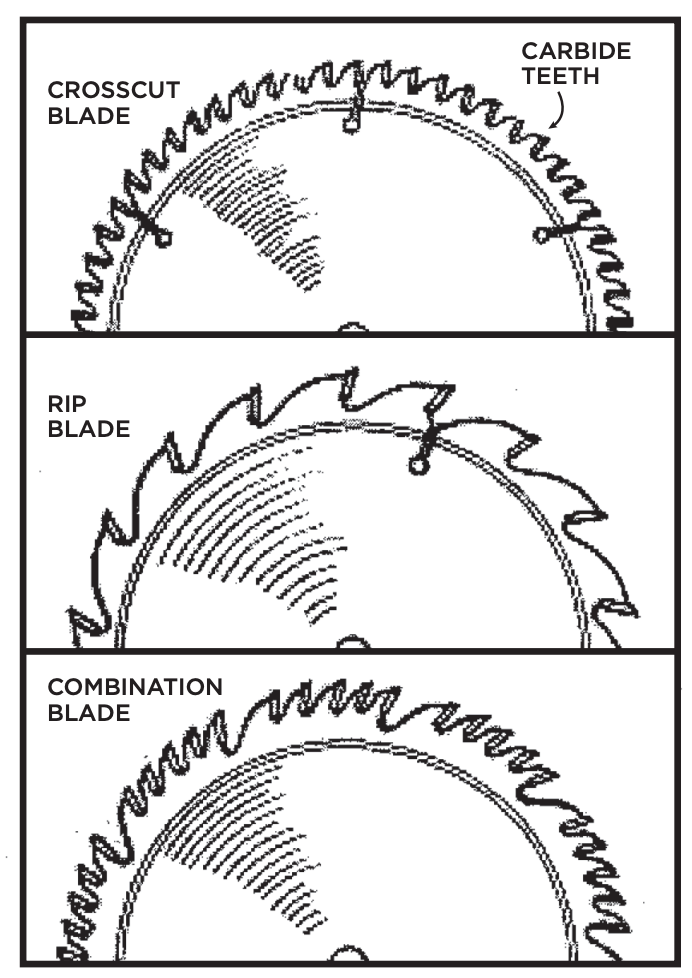
Figure: Common Circular Saw Blade Types
Choosing a Blade
Before selecting a blade, consider:
- Are you ripping or crosscutting?
- Are you cutting solid wood or a manufactured material?
- Is cutting speed or surface quality more important?
- How thick is the material?
- Is the blade sharp and appropriate for the machine?
The correct blade still requires correct machine setup and safe operating technique.
A dull, damaged, or inappropriate blade can produce poor results even when the rest of the setup is correct.
Check Yourself
- What is the gullet of a saw blade?
- What is kerf?
- What generally happens to gullet size as the number of teeth increases?
- Which tooth grind is commonly associated with ripping?
- Which tooth grind is commonly associated with crosscutting?
- Why does a rip blade generally have fewer teeth than a crosscut blade?
- What is the purpose of a combination blade?
- Why is a high tooth count not automatically better for every operation?