

9.10: Tools Checklist and Tips!
- Page ID
- 43378

\( \newcommand{\vecs}[1]{\overset { \scriptstyle \rightharpoonup} {\mathbf{#1}} } \)
\( \newcommand{\vecd}[1]{\overset{-\!-\!\rightharpoonup}{\vphantom{a}\smash {#1}}} \)
\( \newcommand{\dsum}{\displaystyle\sum\limits} \)
\( \newcommand{\dint}{\displaystyle\int\limits} \)
\( \newcommand{\dlim}{\displaystyle\lim\limits} \)
\( \newcommand{\id}{\mathrm{id}}\) \( \newcommand{\Span}{\mathrm{span}}\)
( \newcommand{\kernel}{\mathrm{null}\,}\) \( \newcommand{\range}{\mathrm{range}\,}\)
\( \newcommand{\RealPart}{\mathrm{Re}}\) \( \newcommand{\ImaginaryPart}{\mathrm{Im}}\)
\( \newcommand{\Argument}{\mathrm{Arg}}\) \( \newcommand{\norm}[1]{\| #1 \|}\)
\( \newcommand{\inner}[2]{\langle #1, #2 \rangle}\)
\( \newcommand{\Span}{\mathrm{span}}\)
\( \newcommand{\id}{\mathrm{id}}\)
\( \newcommand{\Span}{\mathrm{span}}\)
\( \newcommand{\kernel}{\mathrm{null}\,}\)
\( \newcommand{\range}{\mathrm{range}\,}\)
\( \newcommand{\RealPart}{\mathrm{Re}}\)
\( \newcommand{\ImaginaryPart}{\mathrm{Im}}\)
\( \newcommand{\Argument}{\mathrm{Arg}}\)
\( \newcommand{\norm}[1]{\| #1 \|}\)
\( \newcommand{\inner}[2]{\langle #1, #2 \rangle}\)
\( \newcommand{\Span}{\mathrm{span}}\) \( \newcommand{\AA}{\unicode[.8,0]{x212B}}\)
\( \newcommand{\vectorA}[1]{\vec{#1}} % arrow\)
\( \newcommand{\vectorAt}[1]{\vec{\text{#1}}} % arrow\)
\( \newcommand{\vectorB}[1]{\overset { \scriptstyle \rightharpoonup} {\mathbf{#1}} } \)
\( \newcommand{\vectorC}[1]{\textbf{#1}} \)
\( \newcommand{\vectorD}[1]{\overrightarrow{#1}} \)
\( \newcommand{\vectorDt}[1]{\overrightarrow{\text{#1}}} \)
\( \newcommand{\vectE}[1]{\overset{-\!-\!\rightharpoonup}{\vphantom{a}\smash{\mathbf {#1}}}} \)
\( \newcommand{\vecs}[1]{\overset { \scriptstyle \rightharpoonup} {\mathbf{#1}} } \)
\(\newcommand{\longvect}{\overrightarrow}\)
\( \newcommand{\vecd}[1]{\overset{-\!-\!\rightharpoonup}{\vphantom{a}\smash {#1}}} \)
\(\newcommand{\ket}[1]{\left| #1 \right>}\)
\(\newcommand{\bra}[1]{\left< #1 \right|}\)
\(\newcommand{\braket}[2]{\left< #1 \vphantom{#2} \right| \left. #2 \vphantom{#1} \right>}\)
\(\newcommand{\braopket}[3]{\left< #1 \vphantom{#2}\vphantom{#3} \right| #2 \vphantom{#1}\vphantom{#3} \left| #3 \vphantom{#1}\vphantom{#2} \right>}\)
\(\newcommand{\qmvec}[1]{\mathbf{\vec{#1}}}\)
\(\newcommand{\op}[1]{\hat{\mathbf{#1}}}\)
\(\newcommand{\expect}[1]{\langle #1 \rangle}\)
\(\newcommand{\dfn}[1]{\emph{\textbf{#1}}}\)
🔧 From the HVAC Expert: Tips and Tricks🔧
Essential Tools for Air Distribution Systems
Airflow Measurement & Balancing Tools:
✔ Anemometer (for measuring airflow velocity)

✔ Digital manometer (for static pressure testing)

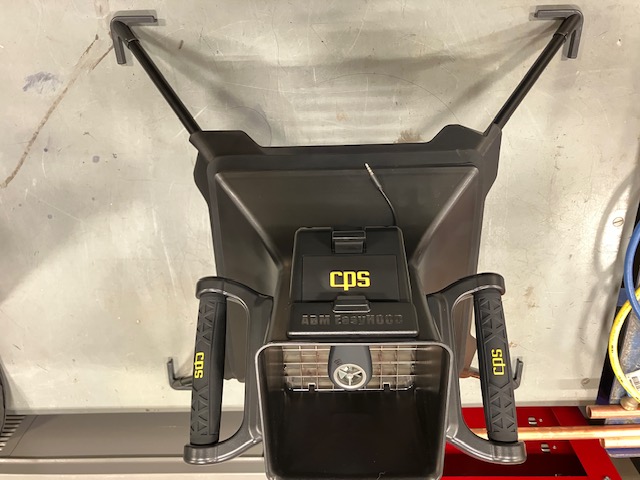
✔ Flow hood (for measuring air volume at diffusers)
✔ Static Pressure Tip (for checking duct air velocity)
Ductwork & Installation Tools:
✔ Sheet metal snips (for cutting ducting materials)
Red = Left-cut Yellow = straight-cut

✔ Duct crimper (for forming tight connections)
✔ Rivet gun (for securing ductwork sections)
✔ Mastic sealant and foil tape (for sealing air leaks)

✔ Insulation knife (for cutting duct insulation)
Inspection & Troubleshooting Tools:
✔ Thermal imaging camera (for detecting temperature inconsistencies)

✔ Static pressure gauge (for system diagnostics)

✔ Psychrometer (for measuring humidity levels)

✔ Duct leakage tester (for identifying air leaks in ductwork)
✔ Decibel meter (for assessing system noise levels)
Pro Tips for Air Distribution System Efficiency
✔ Ensure ducts are properly sealed to prevent air leaks and energy loss.
✔ Regularly clean air filters and diffusers to maintain airflow efficiency.
✔ Balance airflow across the system to prevent pressure imbalances.
✔ Use dampers strategically to control airflow to different zones.
✔ Keep return air pathways clear to maintain even pressure distribution.
✔ Check for duct insulation issues to prevent condensation and heat loss.
✔ Verify fan speed settings to optimize system performance.
HVAC Air Distribution System Maintenance Checklist
✔ Inspect ducts for leaks and gaps.
✔ Measure and balance airflow at supply and return registers.
✔ Check static pressure readings to identify system restrictions.
✔ Clean or replace air filters according to manufacturer recommendations.
✔ Ensure diffusers and grilles are properly adjusted for optimal air distribution.
✔ Monitor humidity levels to prevent mold and indoor air quality issues.
✔ Test fan operation and belt tension for consistent performance.
✔ Inspect insulation on ducts to maintain energy efficiency.