

4.3: How Electrical Shocks Occur
- Page ID
- 63470

\( \newcommand{\vecs}[1]{\overset { \scriptstyle \rightharpoonup} {\mathbf{#1}} } \)
\( \newcommand{\vecd}[1]{\overset{-\!-\!\rightharpoonup}{\vphantom{a}\smash {#1}}} \)
\( \newcommand{\dsum}{\displaystyle\sum\limits} \)
\( \newcommand{\dint}{\displaystyle\int\limits} \)
\( \newcommand{\dlim}{\displaystyle\lim\limits} \)
\( \newcommand{\id}{\mathrm{id}}\) \( \newcommand{\Span}{\mathrm{span}}\)
( \newcommand{\kernel}{\mathrm{null}\,}\) \( \newcommand{\range}{\mathrm{range}\,}\)
\( \newcommand{\RealPart}{\mathrm{Re}}\) \( \newcommand{\ImaginaryPart}{\mathrm{Im}}\)
\( \newcommand{\Argument}{\mathrm{Arg}}\) \( \newcommand{\norm}[1]{\| #1 \|}\)
\( \newcommand{\inner}[2]{\langle #1, #2 \rangle}\)
\( \newcommand{\Span}{\mathrm{span}}\)
\( \newcommand{\id}{\mathrm{id}}\)
\( \newcommand{\Span}{\mathrm{span}}\)
\( \newcommand{\kernel}{\mathrm{null}\,}\)
\( \newcommand{\range}{\mathrm{range}\,}\)
\( \newcommand{\RealPart}{\mathrm{Re}}\)
\( \newcommand{\ImaginaryPart}{\mathrm{Im}}\)
\( \newcommand{\Argument}{\mathrm{Arg}}\)
\( \newcommand{\norm}[1]{\| #1 \|}\)
\( \newcommand{\inner}[2]{\langle #1, #2 \rangle}\)
\( \newcommand{\Span}{\mathrm{span}}\) \( \newcommand{\AA}{\unicode[.8,0]{x212B}}\)
\( \newcommand{\vectorA}[1]{\vec{#1}} % arrow\)
\( \newcommand{\vectorAt}[1]{\vec{\text{#1}}} % arrow\)
\( \newcommand{\vectorB}[1]{\overset { \scriptstyle \rightharpoonup} {\mathbf{#1}} } \)
\( \newcommand{\vectorC}[1]{\textbf{#1}} \)
\( \newcommand{\vectorD}[1]{\overrightarrow{#1}} \)
\( \newcommand{\vectorDt}[1]{\overrightarrow{\text{#1}}} \)
\( \newcommand{\vectE}[1]{\overset{-\!-\!\rightharpoonup}{\vphantom{a}\smash{\mathbf {#1}}}} \)
\( \newcommand{\vecs}[1]{\overset { \scriptstyle \rightharpoonup} {\mathbf{#1}} } \)
\(\newcommand{\longvect}{\overrightarrow}\)
\( \newcommand{\vecd}[1]{\overset{-\!-\!\rightharpoonup}{\vphantom{a}\smash {#1}}} \)
\(\newcommand{\ket}[1]{\left| #1 \right>}\)
\(\newcommand{\bra}[1]{\left< #1 \right|}\)
\(\newcommand{\braket}[2]{\left< #1 \vphantom{#2} \right| \left. #2 \vphantom{#1} \right>}\)
\(\newcommand{\braopket}[3]{\left< #1 \vphantom{#2}\vphantom{#3} \right| #2 \vphantom{#1}\vphantom{#3} \left| #3 \vphantom{#1}\vphantom{#2} \right>}\)
\(\newcommand{\qmvec}[1]{\mathbf{\vec{#1}}}\)
\(\newcommand{\op}[1]{\hat{\mathbf{#1}}}\)
\(\newcommand{\expect}[1]{\langle #1 \rangle}\)
\(\newcommand{\dfn}[1]{\emph{\textbf{#1}}}\)
Electricity travels in closed circuits, normally through a conductor. Typically, shock occurs when a person contacts one wire of an energized circuit and the ground, when a person contacts a metallic part in contact with an energized wire while the person is also in contact with the ground, when a person contacts both wires of an energized circuit.
Factors Affecting Severity of Electrical Shock
■ Amount of current flow ■ Path of current flow ■ Duration of current flow
Electrocution Triangle
The amount of current flowing through the body, the path the current takes through the body and the length of time that the body is in the circuit all have an effect on the severity of an injury; remove any one of these factors from the electrocution triangle, and the potential for injury is reduced.
Contact with Power Lines
Overhead and buried power lines are especially hazardous because they carry extremely high voltage. Fatalities are possible as electrocution is the main risk; however, burns and falls from elevations are also hazards that workers are exposed to while working in the vicinity of high voltage power lines. Workers may not realize that cranes are not the only equipment that reaches overhead power lines. Working on a ladder or in a man-basket suspended under or near power lines also poses a risk of electrocution. Important to note: The covering on an overhead power line is primarily for weather protection; therefore, workers need to know that if they touch a power line, covered or bare, death is probable.
Electrical power is brought to us through a three-part system: “high power transmission lines” running from generating stations to substations, “distribution lines”, the same lines that run through most of our neighborhoods and job sites, and “service drops” running from poles to utility customers. The majority of the power line contacts reported to OSHA involved overhead “distribution” lines. This is due to their proximity to most construction work and their frequency on the landscape.
Example 1:
Two workers were installing aluminum siding on a farmhouse when it became necessary to remove a 36-foot-high metal pole CB antenna. One worker stood on a metal pick board between two ladders and unfastened the antenna at the top of the house. The other worker, who was standing on the ground, took the antenna to lay it down in the yard. The antenna made electrical contact with a 7200-volt power transmission line 30 feet 10 inches from the house and 23 feet 9 inches above the ground. The worker handling the antenna received a fatal shock and the other worker a minor shock.

Image 4:1 Examples of Power Lines. (Source: www.osha.gov, Public Domain).
Example 2:
A lineman was electrocuted while working on grounded de-energized lines. He was working from a defective basket on an articulated boom aerial lift when the basket contacted energized lines which ran beneath the de-energized lines. The defective basket permitted current to pass through a drain hole cut into the body of the basket, then through the worker, and to ground via the de-energized line.
Example 3:
Two workers were spreading concrete as it was being delivered by a concrete pumper truck boom. The truck was parked across the street from the worksite. Overhead power lines ran perpendicular to the boom on the pumper truck. One worker was moving the hose (elephant trunk) to pour the concrete when the boom of the pumper truck came in contact with the overhead rover line carrying 7,620 volts. One worker received a fatal electric shock and fell on the other worker who was assisting him. The second worker received massive electrical shock and burns.
Power Line Myth
Power lines are insulated. Wrong! Any covering you see on an overhead line is generally there for weather protection, not insulation.
Contact with Energized Sources
The major hazards regarding contact with energized sources are electrical shock and burns. Electrical shock occurs when the body becomes part of the electric circuit, either when an individual comes in contact with both wires of an electrical circuit, one wire of an energized circuit and the ground, or a metallic part that has become energized by contact with an electrical conductor.
The severity and effects of an electrical shock depend on a number of factors, such as the pathway through the body, the amount of current, the length of time of the exposure, and whether the skin is wet or dry. Water is a great conductor of electricity, allowing current to flow more easily in wet conditions and through wet skin.
Electrical burns can be arc burns, thermal contact burns, or a combination of burns. Electrical burns are among the most serious burns and require immediate medical attention. They occur when an electric current flows through tissue or bone, generating heat that causes tissue damage. The body cannot dissipate from the heat generated by current flowing through the resistance of the tissue therefore, burns occur. To further illustrate how easily a person can receive a fatal shock, consider a voltage that is common to every location in the United States, 120-volts. Under average working conditions where the person is perspiring and has a resistance of only 1000-ohms from hand-to-hand, using the simple Ohm’s Law formula (current equals the voltage divided by the resistance) the current flow will be 0.12 amperes or 120 mA.
If the power supply to electrical equipment is not grounded or the path has been broken, or if there are live parts or bare wires, a fault current may travel through a worker's body, causing electrical burns or death. Even when the power system is properly grounded, electrical equipment can instantly change from safe to hazardous because of extreme conditions and rough treatment.
Example 1:
The employee was attempting to correct an electrical problem involving two non-operational lamps. He proceeded to the area where he thought the problem was. He had not shut off the power at the circuit breaker panel nor had he tested the wires to see if they were live. He was electrocuted when he grabbed the two live wires with his left hand and then fell from the ladder.

Image 4:2 Electrical Current and Reaction. (Source: www.osha.gov, Public Domain).
Improper use of extension and flexible cords
Because power tools are so common in construction, workers are constantly exposed to a variety of hazards. The very tool that makes a job easy and efficient may one day be the cause of a tragic accident. The normal wear and tear on extension and flexible cords can loosen or expose wires, creating a hazardous condition. Cords that are not 3-wire type, not designed for hard-usage, or that have been modified, increase the risk of contacting electrical current. With the wide use of power tools on construction sites, flexible extension cords are often necessary. Because they are exposed, flexible, and unsecured, they are more susceptible to damage than fixed wiring. Hazards are created when cords, cord connectors, receptacles, and cord- and plug connected equipment are improperly used and maintained. To reduce hazards, flexible cords must connect to devices and to fittings in ways that prevent tension at joints and terminal screws. A flexible cord may be damaged by door or window edges, staples and fastenings, abrasion from adjacent materials, or simply by aging. If the electrical conductors become exposed, there is a danger of shocks, burns, or fire. When a cord connector is wet, electric current can leak to the equipment grounding conductor, and to anyone who picks up that connector if they provide a path to ground. Such leakage can occur not just on the face of the connector, but at any wetted portion.
Example 1:
A fan connected to a 120-volt electrical system via an extension cord provided ventilation for a worker performing a chipping operation from an aluminum stepladder. The insulation on the extension cord was worn through and exposed the bare, energized conductor made contact with the ladder. The ground wire was not attached on the male end of the cord’s plug. When the energized conductor contacted the ladder, the path to ground included the worker’s body, resulting in death.
Example 2:
An 18-year-old worker at a construction site was electrocuted when he touched a light fixture while descending from a scaffold for his afternoon break. The source of the electricity was apparently a short in a receptacle, but examination revealed that the electrical equipment used by the contractor was in such poor condition that it was impossible to make a certain determination of the source of the short. Extension cords had poor splices, no grounds, and reversed polarity. One hand drill was not grounded, and the other had no safety plate. Out of several possible scenarios, the most likely was contact between the exposed wires of an extension cord and a screw that protruded from the receptacle, which had its face plate removed. The light fixture, which served as ground, was known to be faulty for at least 5 months before the incident.
Maintain safe distance from overhead power lines
Staying away from power lines is the best option. The following table shows the safe power line clearance distance for various line voltages.
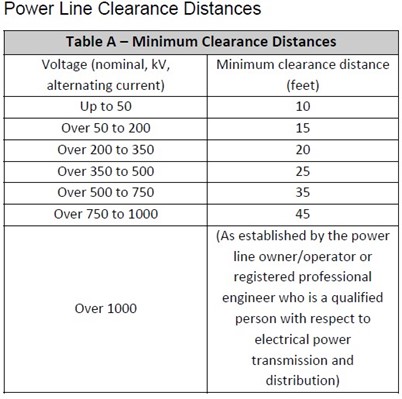
Image 4:3 Power Line Clearance Distances. (Source: www.osha.gov, Public Domain).