

4.7: Factors on Extension Cord Safety
- Page ID
- 63474

\( \newcommand{\vecs}[1]{\overset { \scriptstyle \rightharpoonup} {\mathbf{#1}} } \)
\( \newcommand{\vecd}[1]{\overset{-\!-\!\rightharpoonup}{\vphantom{a}\smash {#1}}} \)
\( \newcommand{\dsum}{\displaystyle\sum\limits} \)
\( \newcommand{\dint}{\displaystyle\int\limits} \)
\( \newcommand{\dlim}{\displaystyle\lim\limits} \)
\( \newcommand{\id}{\mathrm{id}}\) \( \newcommand{\Span}{\mathrm{span}}\)
( \newcommand{\kernel}{\mathrm{null}\,}\) \( \newcommand{\range}{\mathrm{range}\,}\)
\( \newcommand{\RealPart}{\mathrm{Re}}\) \( \newcommand{\ImaginaryPart}{\mathrm{Im}}\)
\( \newcommand{\Argument}{\mathrm{Arg}}\) \( \newcommand{\norm}[1]{\| #1 \|}\)
\( \newcommand{\inner}[2]{\langle #1, #2 \rangle}\)
\( \newcommand{\Span}{\mathrm{span}}\)
\( \newcommand{\id}{\mathrm{id}}\)
\( \newcommand{\Span}{\mathrm{span}}\)
\( \newcommand{\kernel}{\mathrm{null}\,}\)
\( \newcommand{\range}{\mathrm{range}\,}\)
\( \newcommand{\RealPart}{\mathrm{Re}}\)
\( \newcommand{\ImaginaryPart}{\mathrm{Im}}\)
\( \newcommand{\Argument}{\mathrm{Arg}}\)
\( \newcommand{\norm}[1]{\| #1 \|}\)
\( \newcommand{\inner}[2]{\langle #1, #2 \rangle}\)
\( \newcommand{\Span}{\mathrm{span}}\) \( \newcommand{\AA}{\unicode[.8,0]{x212B}}\)
\( \newcommand{\vectorA}[1]{\vec{#1}} % arrow\)
\( \newcommand{\vectorAt}[1]{\vec{\text{#1}}} % arrow\)
\( \newcommand{\vectorB}[1]{\overset { \scriptstyle \rightharpoonup} {\mathbf{#1}} } \)
\( \newcommand{\vectorC}[1]{\textbf{#1}} \)
\( \newcommand{\vectorD}[1]{\overrightarrow{#1}} \)
\( \newcommand{\vectorDt}[1]{\overrightarrow{\text{#1}}} \)
\( \newcommand{\vectE}[1]{\overset{-\!-\!\rightharpoonup}{\vphantom{a}\smash{\mathbf {#1}}}} \)
\( \newcommand{\vecs}[1]{\overset { \scriptstyle \rightharpoonup} {\mathbf{#1}} } \)
\(\newcommand{\longvect}{\overrightarrow}\)
\( \newcommand{\vecd}[1]{\overset{-\!-\!\rightharpoonup}{\vphantom{a}\smash {#1}}} \)
\(\newcommand{\ket}[1]{\left| #1 \right>}\)
\(\newcommand{\bra}[1]{\left< #1 \right|}\)
\(\newcommand{\braket}[2]{\left< #1 \vphantom{#2} \right| \left. #2 \vphantom{#1} \right>}\)
\(\newcommand{\braopket}[3]{\left< #1 \vphantom{#2}\vphantom{#3} \right| #2 \vphantom{#1}\vphantom{#3} \left| #3 \vphantom{#1}\vphantom{#2} \right>}\)
\(\newcommand{\qmvec}[1]{\mathbf{\vec{#1}}}\)
\(\newcommand{\op}[1]{\hat{\mathbf{#1}}}\)
\(\newcommand{\expect}[1]{\langle #1 \rangle}\)
\(\newcommand{\dfn}[1]{\emph{\textbf{#1}}}\)
With the wide use of power tools on construction sites, flexible extension cords often are necessary. Hazards are created when cords, cord connectors, receptacles, and cord- and plug connected equipment are improperly used and maintained. Here are some factors on extension cord safety noted by OSHA.
Strain Relief: To reduce hazards, flexible cords must connect to devices and to fittings in ways that prevent tension at joints and terminal screws. Flexible cords are finely stranded for flexibility, so straining a cord can cause the strands of one conductor to loosen from under terminal screws and touch another conductor.
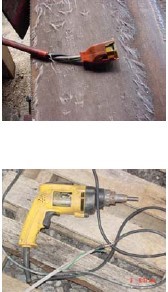
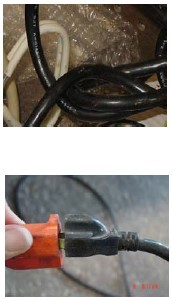

Image 4:4 Extension Cord Safety Hazard Examples. (Source: www.osha.gov, Public Domain).
Cord Damage: A flexible cord may be damaged by door or window edges, by staples and fastenings, by abrasion from adjacent materials, or simply by aging. If the electrical conductors become exposed, there is a danger of shocks, burns, or fire. Replace frayed or damaged cords. Avoid running cords over sharp corners and edges.
Do not repair extension cords by replacing the ends. This will cause the cord to not maintain its approval for its intended use. For example, what was once “W” (moisture and sunlight resistant) will no longer be water-tight if the plug was replaced. Never use an adapter that will make a three-prong cord fit into a two prong receptacle.
Durability: The OSHA construction standard requires flexible cords to be rated for hard or extra-hard usage. These ratings are derived from the National Electrical Code, and are required to be indelibly marked approximately every foot along the length of the cord. Examples of these codes are: S, ST, SO, and STO for hard service, and SJ, SJO, SJT, and SJTO for junior hard service.
Grounding: Extension cords must be 3-wire type so they may be grounded, and to permit grounding of any tools or equipment connected to them.
If the power supply to the electrical equipment at your site is not grounded, or the path has been broken, fault current may travel through a worker's body, causing electrical burns or death. Even when the power system is properly grounded, electrical equipment can instantly change from safe to hazardous because of extreme conditions and rough treatment.
Wet Conditions: When a cord connector is wet, electric current can leak to the equipment grounding conductor, and to anyone who picks up that connectors if they provide a path to ground. Such leakage can occur not just on the face of the conductor, but at any wetter portion. Limit exposure of connectors and tools to excessive moisture by using watertight or sealable connectors.