

8.7: Summary and Review
- Page ID
- 51948

\( \newcommand{\vecs}[1]{\overset { \scriptstyle \rightharpoonup} {\mathbf{#1}} } \)
\( \newcommand{\vecd}[1]{\overset{-\!-\!\rightharpoonup}{\vphantom{a}\smash {#1}}} \)
\( \newcommand{\dsum}{\displaystyle\sum\limits} \)
\( \newcommand{\dint}{\displaystyle\int\limits} \)
\( \newcommand{\dlim}{\displaystyle\lim\limits} \)
\( \newcommand{\id}{\mathrm{id}}\) \( \newcommand{\Span}{\mathrm{span}}\)
( \newcommand{\kernel}{\mathrm{null}\,}\) \( \newcommand{\range}{\mathrm{range}\,}\)
\( \newcommand{\RealPart}{\mathrm{Re}}\) \( \newcommand{\ImaginaryPart}{\mathrm{Im}}\)
\( \newcommand{\Argument}{\mathrm{Arg}}\) \( \newcommand{\norm}[1]{\| #1 \|}\)
\( \newcommand{\inner}[2]{\langle #1, #2 \rangle}\)
\( \newcommand{\Span}{\mathrm{span}}\)
\( \newcommand{\id}{\mathrm{id}}\)
\( \newcommand{\Span}{\mathrm{span}}\)
\( \newcommand{\kernel}{\mathrm{null}\,}\)
\( \newcommand{\range}{\mathrm{range}\,}\)
\( \newcommand{\RealPart}{\mathrm{Re}}\)
\( \newcommand{\ImaginaryPart}{\mathrm{Im}}\)
\( \newcommand{\Argument}{\mathrm{Arg}}\)
\( \newcommand{\norm}[1]{\| #1 \|}\)
\( \newcommand{\inner}[2]{\langle #1, #2 \rangle}\)
\( \newcommand{\Span}{\mathrm{span}}\) \( \newcommand{\AA}{\unicode[.8,0]{x212B}}\)
\( \newcommand{\vectorA}[1]{\vec{#1}} % arrow\)
\( \newcommand{\vectorAt}[1]{\vec{\text{#1}}} % arrow\)
\( \newcommand{\vectorB}[1]{\overset { \scriptstyle \rightharpoonup} {\mathbf{#1}} } \)
\( \newcommand{\vectorC}[1]{\textbf{#1}} \)
\( \newcommand{\vectorD}[1]{\overrightarrow{#1}} \)
\( \newcommand{\vectorDt}[1]{\overrightarrow{\text{#1}}} \)
\( \newcommand{\vectE}[1]{\overset{-\!-\!\rightharpoonup}{\vphantom{a}\smash{\mathbf {#1}}}} \)
\( \newcommand{\vecs}[1]{\overset { \scriptstyle \rightharpoonup} {\mathbf{#1}} } \)
\(\newcommand{\longvect}{\overrightarrow}\)
\( \newcommand{\vecd}[1]{\overset{-\!-\!\rightharpoonup}{\vphantom{a}\smash {#1}}} \)
\(\newcommand{\ket}[1]{\left| #1 \right>}\)
\(\newcommand{\bra}[1]{\left< #1 \right|}\)
\(\newcommand{\braket}[2]{\left< #1 \vphantom{#2} \right| \left. #2 \vphantom{#1} \right>}\)
\(\newcommand{\braopket}[3]{\left< #1 \vphantom{#2}\vphantom{#3} \right| #2 \vphantom{#1}\vphantom{#3} \left| #3 \vphantom{#1}\vphantom{#2} \right>}\)
\(\newcommand{\qmvec}[1]{\mathbf{\vec{#1}}}\)
\(\newcommand{\op}[1]{\hat{\mathbf{#1}}}\)
\(\newcommand{\expect}[1]{\langle #1 \rangle}\)
\(\newcommand{\dfn}[1]{\emph{\textbf{#1}}}\)
Troubleshooting is less about fixing than about understanding. Every sound, vibration, or hesitation has meaning. The operator’s task is to interpret that meaning clearly, one clue at a time. Where maintenance preserves function, troubleshooting restores it—and both rely on patience, logic, and respect for detail.
Across this chapter, the pattern repeats: observe first, act second. Machines reveal their condition through signs, not mysteries. A problem solved quickly is rarely solved well; a problem solved thoughtfully teaches something that prevents the next. In this way, every diagnosis deepens familiarity, turning guesswork into knowledge.
The best troubleshooters share certain traits: they listen more than they talk, they confirm before assuming, and they never let frustration hurry their hands. They view the machine not as a stubborn opponent but as a partner sending signals that need translation. Over time, their intuition becomes as valuable as their tools.
In the Central Valley’s harsh working conditions—dust, heat, and long days—methodical troubleshooting is not optional; it’s survival. The operator who thinks clearly under pressure keeps both tractor and operation moving. And the lesson extends beyond machinery: when challenges arise, slow down, observe, reason, and respond. That sequence is the essence of both mechanical and human problem-solving.
In the end, troubleshooting is simply thinking made visible through action. It’s the craft of turning observation into certainty, uncertainty into order, and disorder back into dependable motion. That quiet logic—steady, deliberate, and learned through work—defines not only the skilled operator but the enduring strength of agriculture itself.
Review Questions
-
What are the key steps in a systematic troubleshooting process?
-
How can recognizing symptom patterns help identify the root cause of a problem?
-
List at least three common causes of starting failure and overheating.
-
What safety precautions must always be taken before inspecting a tractor?
-
When should an operator seek professional assistance?
-
How does preventive maintenance reduce the need for future troubleshooting?
- Provide one example of a troubleshooting issue specific to California’s Central Valley conditions.
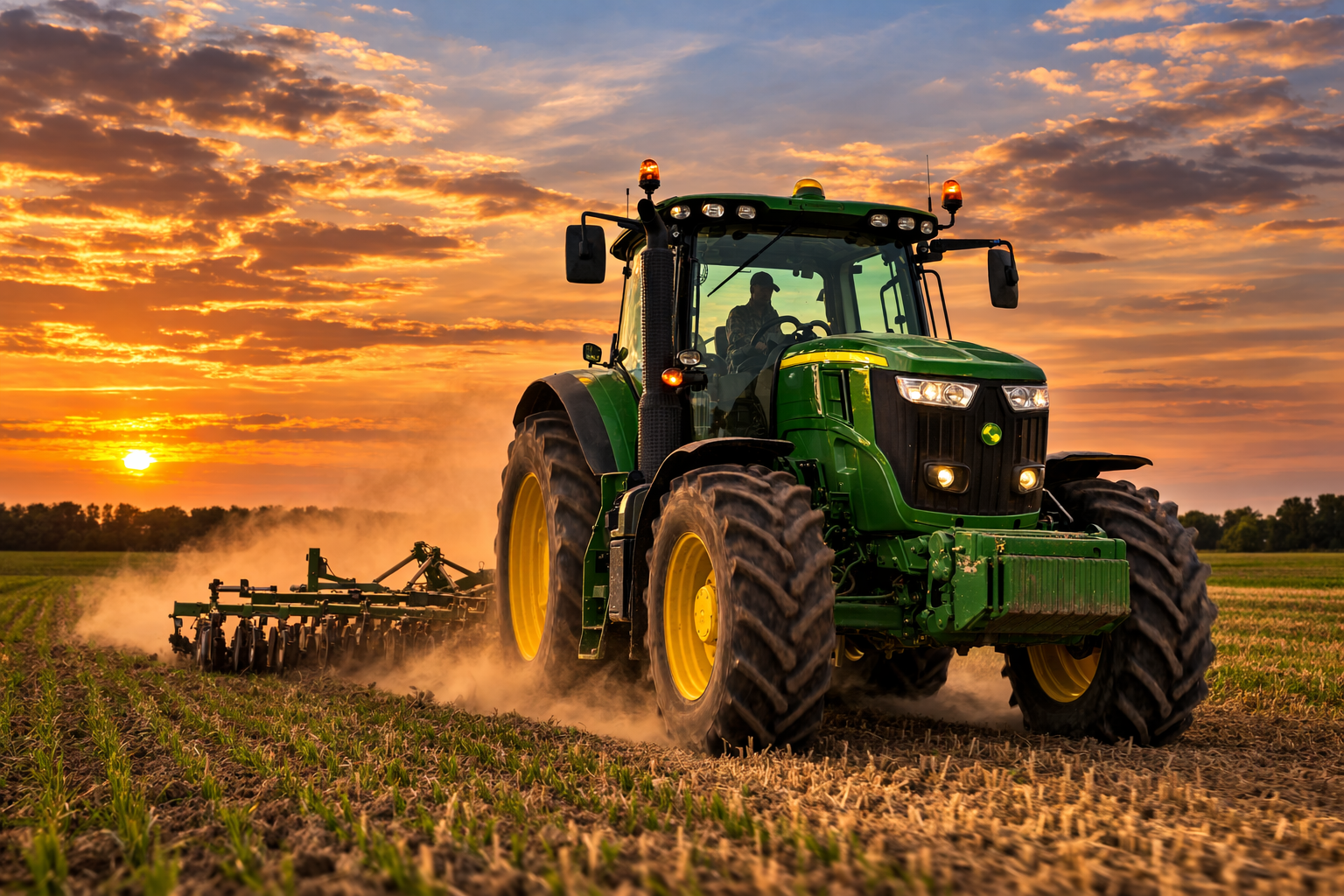
Fig. 8.7.1 "create an image of a tractor working on a field" (prompt), ChatGPT, OpenAI, 15 Feb. 2026, https://chat.openai.com. Copyright status: No copyright claimed (U.S.); AI-generated work.