

10.1: Background
- Page ID
- 63358

\( \newcommand{\vecs}[1]{\overset { \scriptstyle \rightharpoonup} {\mathbf{#1}} } \)
\( \newcommand{\vecd}[1]{\overset{-\!-\!\rightharpoonup}{\vphantom{a}\smash {#1}}} \)
\( \newcommand{\dsum}{\displaystyle\sum\limits} \)
\( \newcommand{\dint}{\displaystyle\int\limits} \)
\( \newcommand{\dlim}{\displaystyle\lim\limits} \)
\( \newcommand{\id}{\mathrm{id}}\) \( \newcommand{\Span}{\mathrm{span}}\)
( \newcommand{\kernel}{\mathrm{null}\,}\) \( \newcommand{\range}{\mathrm{range}\,}\)
\( \newcommand{\RealPart}{\mathrm{Re}}\) \( \newcommand{\ImaginaryPart}{\mathrm{Im}}\)
\( \newcommand{\Argument}{\mathrm{Arg}}\) \( \newcommand{\norm}[1]{\| #1 \|}\)
\( \newcommand{\inner}[2]{\langle #1, #2 \rangle}\)
\( \newcommand{\Span}{\mathrm{span}}\)
\( \newcommand{\id}{\mathrm{id}}\)
\( \newcommand{\Span}{\mathrm{span}}\)
\( \newcommand{\kernel}{\mathrm{null}\,}\)
\( \newcommand{\range}{\mathrm{range}\,}\)
\( \newcommand{\RealPart}{\mathrm{Re}}\)
\( \newcommand{\ImaginaryPart}{\mathrm{Im}}\)
\( \newcommand{\Argument}{\mathrm{Arg}}\)
\( \newcommand{\norm}[1]{\| #1 \|}\)
\( \newcommand{\inner}[2]{\langle #1, #2 \rangle}\)
\( \newcommand{\Span}{\mathrm{span}}\) \( \newcommand{\AA}{\unicode[.8,0]{x212B}}\)
\( \newcommand{\vectorA}[1]{\vec{#1}} % arrow\)
\( \newcommand{\vectorAt}[1]{\vec{\text{#1}}} % arrow\)
\( \newcommand{\vectorB}[1]{\overset { \scriptstyle \rightharpoonup} {\mathbf{#1}} } \)
\( \newcommand{\vectorC}[1]{\textbf{#1}} \)
\( \newcommand{\vectorD}[1]{\overrightarrow{#1}} \)
\( \newcommand{\vectorDt}[1]{\overrightarrow{\text{#1}}} \)
\( \newcommand{\vectE}[1]{\overset{-\!-\!\rightharpoonup}{\vphantom{a}\smash{\mathbf {#1}}}} \)
\( \newcommand{\vecs}[1]{\overset { \scriptstyle \rightharpoonup} {\mathbf{#1}} } \)
\(\newcommand{\longvect}{\overrightarrow}\)
\( \newcommand{\vecd}[1]{\overset{-\!-\!\rightharpoonup}{\vphantom{a}\smash {#1}}} \)
\(\newcommand{\ket}[1]{\left| #1 \right>}\)
\(\newcommand{\bra}[1]{\left< #1 \right|}\)
\(\newcommand{\braket}[2]{\left< #1 \vphantom{#2} \right| \left. #2 \vphantom{#1} \right>}\)
\(\newcommand{\braopket}[3]{\left< #1 \vphantom{#2}\vphantom{#3} \right| #2 \vphantom{#1}\vphantom{#3} \left| #3 \vphantom{#1}\vphantom{#2} \right>}\)
\(\newcommand{\qmvec}[1]{\mathbf{\vec{#1}}}\)
\(\newcommand{\op}[1]{\hat{\mathbf{#1}}}\)
\(\newcommand{\expect}[1]{\langle #1 \rangle}\)
\(\newcommand{\dfn}[1]{\emph{\textbf{#1}}}\)
Noise, or unwanted sound, is one of the most pervasive occupational health problems. It is a by-product of many industrial processes. Sound consists of pressure changes in a medium (usually air), caused by vibration or turbulence. These pressure changes produce waves emanating away from the turbulent or vibrating source. Exposure to high levels of noise causes hearing loss and may cause other harmful health effects as well. The extent of damage depends primarily on the intensity of the noise and the duration of the exposure. Noise-induced hearing loss can be temporary or permanent. Temporary hearing loss results from short-term exposures to noise, with normal hearing returning after period of rest. Generally, prolonged exposure to high noise levels over a period of time gradually causes permanent damage.
Construction sites have many noisy operations and can be a significant source of noise exposure. Loud noise can also reduce work productivity and contribute to workplace accidents by making it difficult to hear warning signals. Hearing loss from loud noise limits your ability to hear high frequencies, understand speech, and reduces your ability to communicate, which can lead to social isolation. Hearing loss can affect your quality of life by interfering with your ability to enjoy socializing with friends, playing with your children or grandchildren, or participating in other activities. Damage to your hearing can be prevented, but once permanent noise-induced hearing loss occurs, it cannot be cured or reversed. Hearing loss usually occurs gradually, so you may not realize it is happening until it is too late. Noise can also affect your body in other ways. A recent study found that workers persistently exposed to excessive occupational noise may be two-to-three times more likely to suffer from serious heart disease than workers who were not exposed.
How does hearing damage happen?
A one-time exposure to a sudden powerful noise, such as an explosion, may damage your hearing instantly. Prolonged exposures to loud noise can lead to a gradual, but permanent, loss of hearing. Damage can occur within the ear at noise levels similar to that of running a lawn mower for eight hours. At first, this may cause a temporary loss of hearing that may last as long as 14-16 hours. With repeated exposure to high noise levels and periodic exposures to very high noise levels (e.g., with the use of nail guns), as is common at most construction job sites, your hearing may not fully recover. More often, the loss of hearing occurs slowly over time from exposure to moderate levels of noise. When that happens, the hearing loss becomes permanent. This is why workplace noise is sometimes referred to as a stealth long-term hazard – because it is a painless, gradual process.
Hearing loss occurs when cilia, tiny hair cells that line the inner ear, are damaged. At first, the damage happens to the cilia that receive the higher frequencies. Gradually, noise damages more of the ear and affects how speech is heard. If you hear muffled or distorted speech sounds, that may be an indication that a substantial hearing loss has already occurred.
In addition to hearing loss, you also may experience ringing in the ears. This is called tinnitus, and can occur even without other apparent hearing loss.
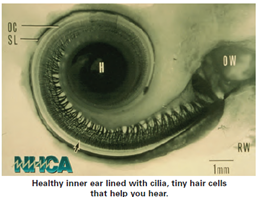

Image 10:1 Healthy and Damaged Inner Ears. (Source: www.osha.gov, Public Domain).
Exposure to high levels of noise can cause permanent hearing loss. Neither surgery nor a hearing aid can correct this type of hearing loss. Short term exposure to loud noise can cause a temporary change in hearing (your ears may feel plugged) or a ringing in your ears (tinnitus). These short-term problems may go away within a few minutes or hours after leaving the noise. However, repeated exposure can lead to permanent tinnitus and/or hearing loss. Loud noise can create physical and psychological stress, reduce productivity, interfere with communication and concentration, and contribute to workplace accidents and injuries by making it difficult to hear warning signals. The effects of noise induced hearing loss can be profound, permanently limiting your ability to hear high frequency sounds, understand speech, and seriously impairing your ability to communicate.
What is noise?
Noise and vibration are both fluctuations in the pressure of air (or other media) which affect the human body. Vibrations that are detected by the human ear are classified as sound. We use the term 'noise' to indicate unwanted sound. Noise and vibration can harm workers when they occur at high levels, or continue for a long time.
Noise is measured in units of sound pressure levels called decibels, named after Alexander Graham Bell, using A-weighted sound levels (dBA). The A-weighted sound levels closely match the perception of loudness by the human ear. Decibels are measured on a logarithmic scale which means that a small change in the number of decibels results in a huge change in the amount of noise and the potential damage to a person's hearing. OSHA sets legal limits on noise exposure in the workplace. These limits are based on a worker's time weighted average over an 8-hour day. With noise, OSHA's permissible exposure limit (PEL) is 90 dBA for all workers for an 8-hour day. The OSHA standard uses a 5 dBA exchange rate. This means that when the noise level is increased by 5 dBA, the amount of time a person can be exposed to a certain noise level to receive the same dose is cut in half. The National Institute for Occupational Safety and Health (NIOSH) has recommended that all worker exposures to noise should be controlled below a level equivalent to 85 dBA for eight hours to minimize occupational noise induced hearing loss. NIOSH has found that significant noise-induced hearing loss occurs at the exposure levels equivalent to the OSHA PEL based on updated information obtained from literature reviews. NIOSH also recommends a 3 dBA exchange rate so that every increase by 3 dBA doubles the amount of noise and halves the recommended amount of exposure time.
How does the ear work?
When sound waves enter the outer ear, the vibrations impact the ear drum and are transmitted to the middle and inner ear. In the middle ear three small bones called the malleus (or hammer), the incus (or anvil), and the stapes (or stirrup) amplify and transmit the vibrations generated by the sound to the inner ear. The inner ear contains a snail-like structure called cochlea which is filled with fluid and lined with cells with very fine hairs. These microscopic hairs move with the vibrations and convert the sound waves into nerve impulses–the result is the sound we hear. Exposure to loud noise can destroy these hair cells and cause hearing loss!
How do I know if my tools or job site are too noisy?
Sound intensity is measured in decibels. When decibels are adjusted for how the ear senses sound, the sound level intensity is measured as dBA. So, if the level increases by 3 dBA this doubles the amount of noise and reduces the recommended amount of exposure time by half. Safety and health inspectors measure sound or noise levels using a device called a sound level meter. The microphone is positioned at the user’s ear level. Equipment that is determined to be loud can be labeled with a hazardous noise sticker. OSHA uses noise dosimeters to document the average noise exposure over your working day or of a particular task for part of your workday. OSHA recommends that workplace noise levels be kept below 85 dBA as an 8-hour time-weighted average. As the noise level increases, it damages your hearing more quickly.
Research indicates that your hearing can be damaged by regular 8-hour exposures to 85 dBA. When noise is as loud as 100 dBA (like a jackhammer or stud welder), it can take repeated exposures of as little as 1 hour per day to damage your hearing.
Noise is likely a problem in your workplace if you:
• Hear ringing or humming in your ears when you leave work.
• Have to shout to be heard by a coworker an arm’s length away.
• Experience temporary hearing loss when leaving work.