

1.1: Overview
- Page ID
- 53470

\( \newcommand{\vecs}[1]{\overset { \scriptstyle \rightharpoonup} {\mathbf{#1}} } \)
\( \newcommand{\vecd}[1]{\overset{-\!-\!\rightharpoonup}{\vphantom{a}\smash {#1}}} \)
\( \newcommand{\dsum}{\displaystyle\sum\limits} \)
\( \newcommand{\dint}{\displaystyle\int\limits} \)
\( \newcommand{\dlim}{\displaystyle\lim\limits} \)
\( \newcommand{\id}{\mathrm{id}}\) \( \newcommand{\Span}{\mathrm{span}}\)
( \newcommand{\kernel}{\mathrm{null}\,}\) \( \newcommand{\range}{\mathrm{range}\,}\)
\( \newcommand{\RealPart}{\mathrm{Re}}\) \( \newcommand{\ImaginaryPart}{\mathrm{Im}}\)
\( \newcommand{\Argument}{\mathrm{Arg}}\) \( \newcommand{\norm}[1]{\| #1 \|}\)
\( \newcommand{\inner}[2]{\langle #1, #2 \rangle}\)
\( \newcommand{\Span}{\mathrm{span}}\)
\( \newcommand{\id}{\mathrm{id}}\)
\( \newcommand{\Span}{\mathrm{span}}\)
\( \newcommand{\kernel}{\mathrm{null}\,}\)
\( \newcommand{\range}{\mathrm{range}\,}\)
\( \newcommand{\RealPart}{\mathrm{Re}}\)
\( \newcommand{\ImaginaryPart}{\mathrm{Im}}\)
\( \newcommand{\Argument}{\mathrm{Arg}}\)
\( \newcommand{\norm}[1]{\| #1 \|}\)
\( \newcommand{\inner}[2]{\langle #1, #2 \rangle}\)
\( \newcommand{\Span}{\mathrm{span}}\) \( \newcommand{\AA}{\unicode[.8,0]{x212B}}\)
\( \newcommand{\vectorA}[1]{\vec{#1}} % arrow\)
\( \newcommand{\vectorAt}[1]{\vec{\text{#1}}} % arrow\)
\( \newcommand{\vectorB}[1]{\overset { \scriptstyle \rightharpoonup} {\mathbf{#1}} } \)
\( \newcommand{\vectorC}[1]{\textbf{#1}} \)
\( \newcommand{\vectorD}[1]{\overrightarrow{#1}} \)
\( \newcommand{\vectorDt}[1]{\overrightarrow{\text{#1}}} \)
\( \newcommand{\vectE}[1]{\overset{-\!-\!\rightharpoonup}{\vphantom{a}\smash{\mathbf {#1}}}} \)
\( \newcommand{\vecs}[1]{\overset { \scriptstyle \rightharpoonup} {\mathbf{#1}} } \)
\(\newcommand{\longvect}{\overrightarrow}\)
\( \newcommand{\vecd}[1]{\overset{-\!-\!\rightharpoonup}{\vphantom{a}\smash {#1}}} \)
\(\newcommand{\ket}[1]{\left| #1 \right>}\)
\(\newcommand{\bra}[1]{\left< #1 \right|}\)
\(\newcommand{\braket}[2]{\left< #1 \vphantom{#2} \right| \left. #2 \vphantom{#1} \right>}\)
\(\newcommand{\braopket}[3]{\left< #1 \vphantom{#2}\vphantom{#3} \right| #2 \vphantom{#1}\vphantom{#3} \left| #3 \vphantom{#1}\vphantom{#2} \right>}\)
\(\newcommand{\qmvec}[1]{\mathbf{\vec{#1}}}\)
\(\newcommand{\op}[1]{\hat{\mathbf{#1}}}\)
\(\newcommand{\expect}[1]{\langle #1 \rangle}\)
\(\newcommand{\dfn}[1]{\emph{\textbf{#1}}}\)
- Describe how tractors transformed agriculture from animal power to mechanized power.
- Outline major milestones in tractor development from the 1800s to the present.
- Identify key tractor manufacturers and their areas of innovation.
- Distinguish among common tractor types and configurations.
- Explain the main uses of tractors in farming and beyond.
- Perform and understand the purpose of a pre-operation inspection.
- Demonstrate awareness of tractor operation basics and safety procedures.
Tractors have completely transformed the way humans farm. Before their invention, most agricultural work relied on human labor or animal power—teams of horses or oxen pulling plows through the soil. Farming was hard, time-consuming, and exhausting.

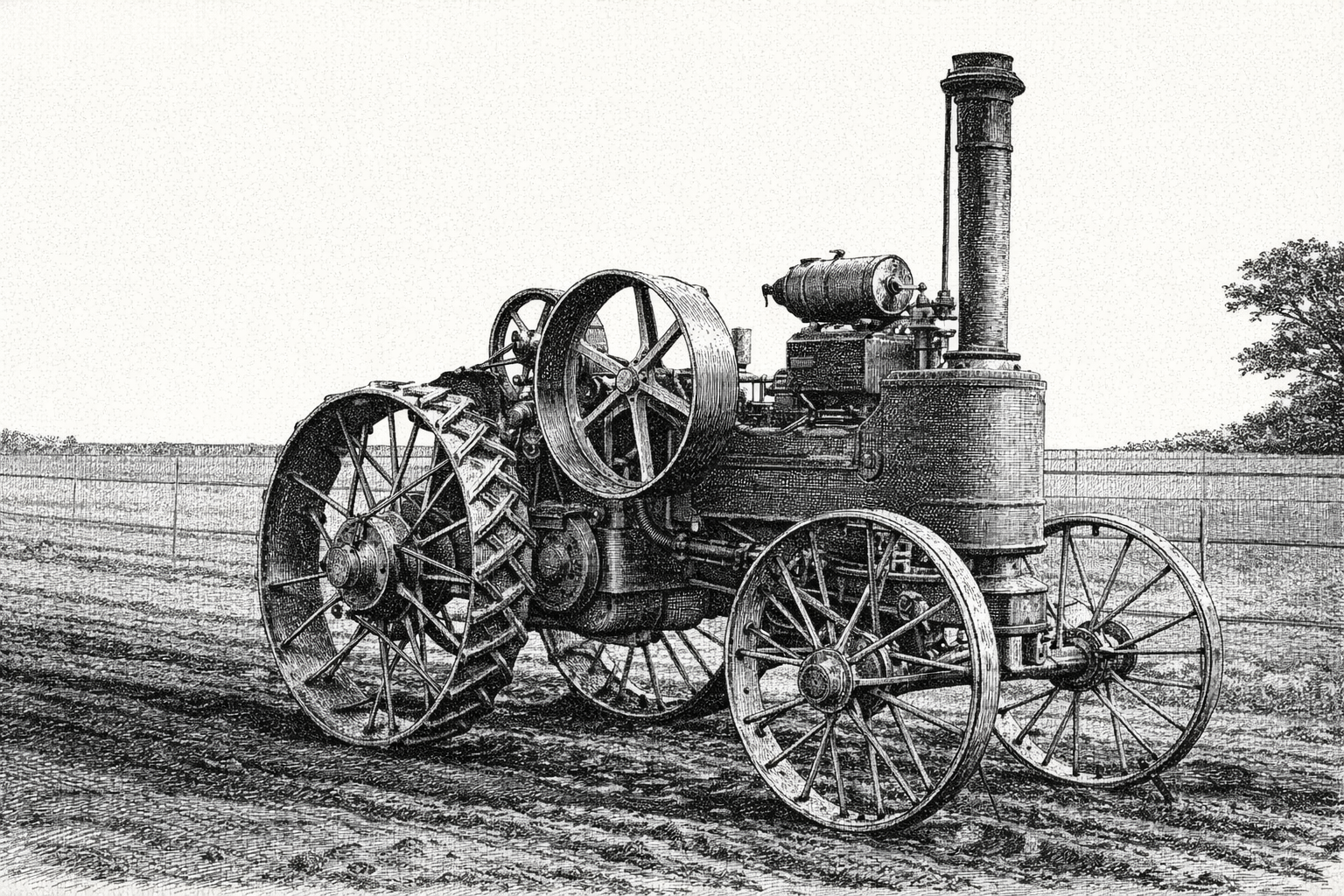
That began to change in the late 1800s and early 1900s when steam-powered engines first appeared on farms. These early tractors were massive and difficult to operate, but they marked the beginning of mechanical agriculture. Machines, unlike animals, did not tire and could work for long hours, paving the way for a new era of productivity.

The next great leap came with the introduction of gasoline engines. The first gasoline-powered tractor was built in 1901, and by the 1920s companies like John Deere and Ford were manufacturing smaller, more affordable, and easier-to-operate machines. These tractors quickly replaced horses and oxen as the main source of farm power, allowing farmers to accomplish much more in far less time.
Today’s tractors are marvels of precision engineering. Many feature GPS guidance, automatic steering, and smart data-collection systems that help farmers make informed decisions about planting, watering, and harvesting. They are central to precision agriculture—the modern approach that produces more food with fewer resources and less environmental impact. From bulky steam engines to intelligent self-driving machines, tractors remain one of the most important tools feeding the world.

Fig. [1.1.0]. "make a picture of a oxen drawn plow" (prompt), ChatGPT, OpenAI, 20 Feb. 2025, https://chat.openai.com. Copyright status: No copyright claimed (U.S.); AI-generated work.
Fig. [1.1.1]. "create an image of a tractor steam engine" (prompt), ChatGPT, OpenAI, 15 Feb. 2026, https://chat.openai.com. Copyright status: No copyright claimed (U.S.); AI-generated work.
Fig. [1.1.2]. "make a drawn image of an early day gasoline powered tractor" (prompt), ChatGPT, OpenAI, 15 Feb. 2026, https://chat.openai.com. Copyright status: No copyright claimed (U.S.); AI-generated work.
Fig. [1.1.3]. "create an image of John Deere's flagship tractor" (prompt), ChatGPT, OpenAI, 15 Feb. 2026, https://chat.openai.com. Copyright status: No copyright claimed (U.S.); AI-generated work.