

8.1: Overview
- Page ID
- 53557

\( \newcommand{\vecs}[1]{\overset { \scriptstyle \rightharpoonup} {\mathbf{#1}} } \)
\( \newcommand{\vecd}[1]{\overset{-\!-\!\rightharpoonup}{\vphantom{a}\smash {#1}}} \)
\( \newcommand{\dsum}{\displaystyle\sum\limits} \)
\( \newcommand{\dint}{\displaystyle\int\limits} \)
\( \newcommand{\dlim}{\displaystyle\lim\limits} \)
\( \newcommand{\id}{\mathrm{id}}\) \( \newcommand{\Span}{\mathrm{span}}\)
( \newcommand{\kernel}{\mathrm{null}\,}\) \( \newcommand{\range}{\mathrm{range}\,}\)
\( \newcommand{\RealPart}{\mathrm{Re}}\) \( \newcommand{\ImaginaryPart}{\mathrm{Im}}\)
\( \newcommand{\Argument}{\mathrm{Arg}}\) \( \newcommand{\norm}[1]{\| #1 \|}\)
\( \newcommand{\inner}[2]{\langle #1, #2 \rangle}\)
\( \newcommand{\Span}{\mathrm{span}}\)
\( \newcommand{\id}{\mathrm{id}}\)
\( \newcommand{\Span}{\mathrm{span}}\)
\( \newcommand{\kernel}{\mathrm{null}\,}\)
\( \newcommand{\range}{\mathrm{range}\,}\)
\( \newcommand{\RealPart}{\mathrm{Re}}\)
\( \newcommand{\ImaginaryPart}{\mathrm{Im}}\)
\( \newcommand{\Argument}{\mathrm{Arg}}\)
\( \newcommand{\norm}[1]{\| #1 \|}\)
\( \newcommand{\inner}[2]{\langle #1, #2 \rangle}\)
\( \newcommand{\Span}{\mathrm{span}}\) \( \newcommand{\AA}{\unicode[.8,0]{x212B}}\)
\( \newcommand{\vectorA}[1]{\vec{#1}} % arrow\)
\( \newcommand{\vectorAt}[1]{\vec{\text{#1}}} % arrow\)
\( \newcommand{\vectorB}[1]{\overset { \scriptstyle \rightharpoonup} {\mathbf{#1}} } \)
\( \newcommand{\vectorC}[1]{\textbf{#1}} \)
\( \newcommand{\vectorD}[1]{\overrightarrow{#1}} \)
\( \newcommand{\vectorDt}[1]{\overrightarrow{\text{#1}}} \)
\( \newcommand{\vectE}[1]{\overset{-\!-\!\rightharpoonup}{\vphantom{a}\smash{\mathbf {#1}}}} \)
\( \newcommand{\vecs}[1]{\overset { \scriptstyle \rightharpoonup} {\mathbf{#1}} } \)
\(\newcommand{\longvect}{\overrightarrow}\)
\( \newcommand{\vecd}[1]{\overset{-\!-\!\rightharpoonup}{\vphantom{a}\smash {#1}}} \)
\(\newcommand{\ket}[1]{\left| #1 \right>}\)
\(\newcommand{\bra}[1]{\left< #1 \right|}\)
\(\newcommand{\braket}[2]{\left< #1 \vphantom{#2} \right| \left. #2 \vphantom{#1} \right>}\)
\(\newcommand{\braopket}[3]{\left< #1 \vphantom{#2}\vphantom{#3} \right| #2 \vphantom{#1}\vphantom{#3} \left| #3 \vphantom{#1}\vphantom{#2} \right>}\)
\(\newcommand{\qmvec}[1]{\mathbf{\vec{#1}}}\)
\(\newcommand{\op}[1]{\hat{\mathbf{#1}}}\)
\(\newcommand{\expect}[1]{\langle #1 \rangle}\)
\(\newcommand{\dfn}[1]{\emph{\textbf{#1}}}\)
- Explain the importance of systematic troubleshooting for efficient tractor operation.
- Identify common symptoms of mechanical, electrical, fuel, and hydraulic problems.
- Apply a logical, step-by-step diagnostic approach to isolate faults.
- Recognize key safety precautions when inspecting or repairing tractor systems.
- Determine when to seek professional technical assistance.
- Integrate troubleshooting practices with regular maintenance to prevent recurring issues.
Even the best-maintained tractor will eventually falter. Machines age, seals wear, filters clog, and electrical systems lose their clean precision. Yet a breakdown is not a defeat—it’s an invitation to think. Troubleshooting is the craft of diagnosis: the ability to read symptoms, recognize patterns, and trace causes logically from effect to origin. It is less about tools than about observation and reasoning.
In the Central Valley, this craft is tested constantly. Tractors here operate in a punishing cycle of heat, dust, and vibration. Fine soil particles infiltrate electrical connectors, plug air filters, and grind at hydraulic seals. Engines that start easily in March may struggle by August after hundreds of hours under load. Even so, the difference between a short delay and a full shutdown often lies not in the complexity of the problem, but in the operator’s calm, methodical approach.
Troubleshooting is a discipline built on patience. It begins not with the wrench, but with the senses. A sputtering idle, a flickering gauge, a faint change in exhaust tone—all are clues in a larger story. The successful operator learns to pause, listen, and let the tractor speak. Machines rarely fail without warning; they simply communicate in mechanical language. Reading that language is the essence of diagnosis.
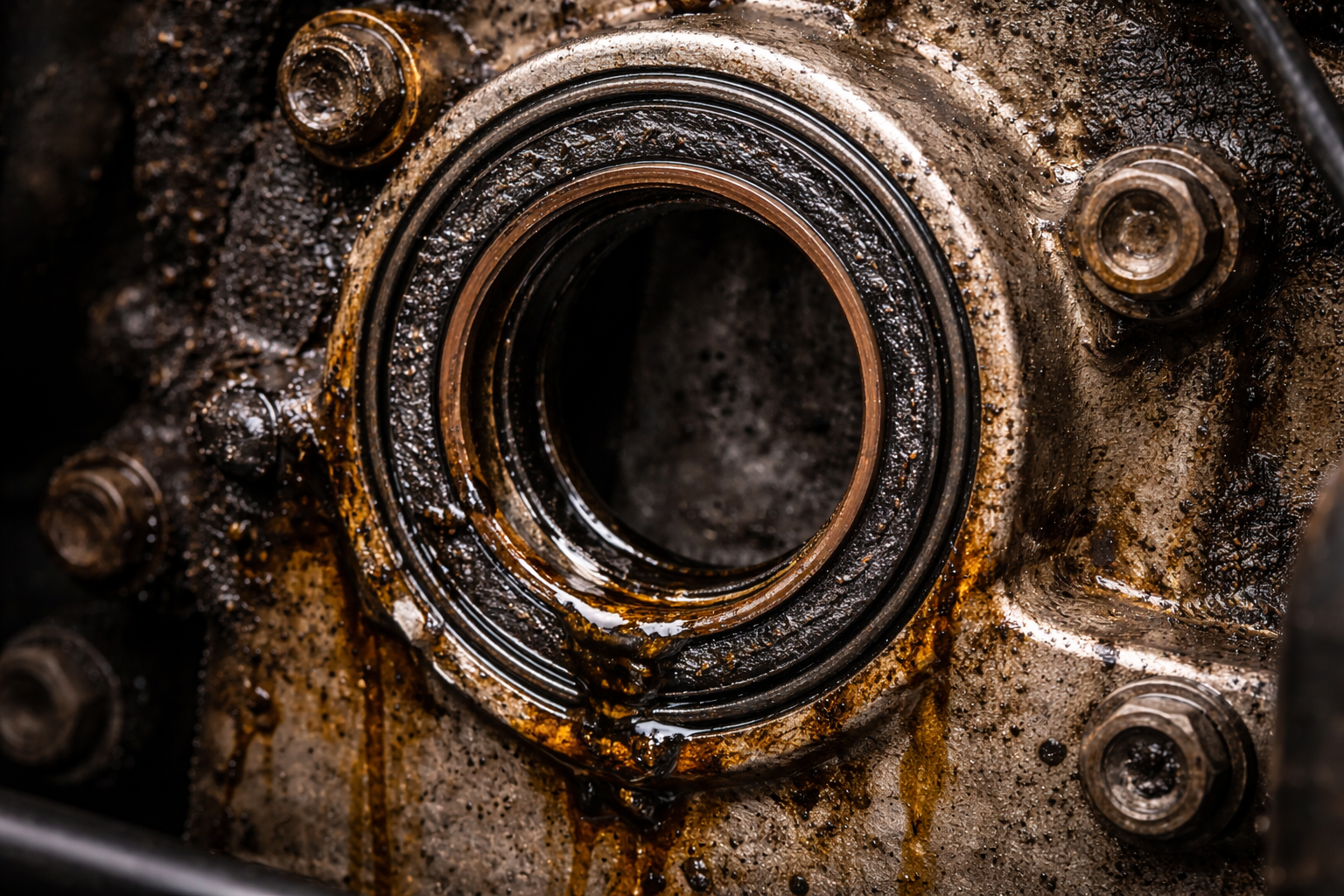
Fig. 8.1.1 "create an image of a worn engine seal" (prompt), ChatGPT, OpenAI, 15 Feb. 2026, https://chat.openai.com. Copyright status: No copyright claimed (U.S.); AI-generated work.