

8.2: Common Problems and Patterns
- Page ID
- 51943

\( \newcommand{\vecs}[1]{\overset { \scriptstyle \rightharpoonup} {\mathbf{#1}} } \)
\( \newcommand{\vecd}[1]{\overset{-\!-\!\rightharpoonup}{\vphantom{a}\smash {#1}}} \)
\( \newcommand{\dsum}{\displaystyle\sum\limits} \)
\( \newcommand{\dint}{\displaystyle\int\limits} \)
\( \newcommand{\dlim}{\displaystyle\lim\limits} \)
\( \newcommand{\id}{\mathrm{id}}\) \( \newcommand{\Span}{\mathrm{span}}\)
( \newcommand{\kernel}{\mathrm{null}\,}\) \( \newcommand{\range}{\mathrm{range}\,}\)
\( \newcommand{\RealPart}{\mathrm{Re}}\) \( \newcommand{\ImaginaryPart}{\mathrm{Im}}\)
\( \newcommand{\Argument}{\mathrm{Arg}}\) \( \newcommand{\norm}[1]{\| #1 \|}\)
\( \newcommand{\inner}[2]{\langle #1, #2 \rangle}\)
\( \newcommand{\Span}{\mathrm{span}}\)
\( \newcommand{\id}{\mathrm{id}}\)
\( \newcommand{\Span}{\mathrm{span}}\)
\( \newcommand{\kernel}{\mathrm{null}\,}\)
\( \newcommand{\range}{\mathrm{range}\,}\)
\( \newcommand{\RealPart}{\mathrm{Re}}\)
\( \newcommand{\ImaginaryPart}{\mathrm{Im}}\)
\( \newcommand{\Argument}{\mathrm{Arg}}\)
\( \newcommand{\norm}[1]{\| #1 \|}\)
\( \newcommand{\inner}[2]{\langle #1, #2 \rangle}\)
\( \newcommand{\Span}{\mathrm{span}}\) \( \newcommand{\AA}{\unicode[.8,0]{x212B}}\)
\( \newcommand{\vectorA}[1]{\vec{#1}} % arrow\)
\( \newcommand{\vectorAt}[1]{\vec{\text{#1}}} % arrow\)
\( \newcommand{\vectorB}[1]{\overset { \scriptstyle \rightharpoonup} {\mathbf{#1}} } \)
\( \newcommand{\vectorC}[1]{\textbf{#1}} \)
\( \newcommand{\vectorD}[1]{\overrightarrow{#1}} \)
\( \newcommand{\vectorDt}[1]{\overrightarrow{\text{#1}}} \)
\( \newcommand{\vectE}[1]{\overset{-\!-\!\rightharpoonup}{\vphantom{a}\smash{\mathbf {#1}}}} \)
\( \newcommand{\vecs}[1]{\overset { \scriptstyle \rightharpoonup} {\mathbf{#1}} } \)
\(\newcommand{\longvect}{\overrightarrow}\)
\( \newcommand{\vecd}[1]{\overset{-\!-\!\rightharpoonup}{\vphantom{a}\smash {#1}}} \)
\(\newcommand{\ket}[1]{\left| #1 \right>}\)
\(\newcommand{\bra}[1]{\left< #1 \right|}\)
\(\newcommand{\braket}[2]{\left< #1 \vphantom{#2} \right| \left. #2 \vphantom{#1} \right>}\)
\(\newcommand{\braopket}[3]{\left< #1 \vphantom{#2}\vphantom{#3} \right| #2 \vphantom{#1}\vphantom{#3} \left| #3 \vphantom{#1}\vphantom{#2} \right>}\)
\(\newcommand{\qmvec}[1]{\mathbf{\vec{#1}}}\)
\(\newcommand{\op}[1]{\hat{\mathbf{#1}}}\)
\(\newcommand{\expect}[1]{\langle #1 \rangle}\)
\(\newcommand{\dfn}[1]{\emph{\textbf{#1}}}\)
Most tractor issues fall into a few familiar categories: starting failures, loss of power, overheating, and hydraulic or electrical malfunctions. Each has its own signature symptoms, and the key to solving them is recognizing what’s normal before deciding what’s wrong.
A starting failure, for instance, can begin with silence—a dead starter—or a slow crank that suggests weak voltage or corroded terminals. Sometimes the engine spins freely but never catches, pointing to a fuel delivery problem: an air leak in the line, a clogged filter, or water condensed in the tank after a cool night. A diesel engine that cranks endlessly without smoke from the exhaust often means no fuel is reaching the injectors at all.
Loss of power reveals itself more subtly. The tractor still runs, but labors on slopes where it once climbed easily, or the PTO slows when engaging heavy equipment. In the Central Valley, operators often trace this to dust-choked air filters or fuel filters long past their service life. At a vineyard in Madera County, a grower once spent half a morning blaming a weak hydraulic pump before discovering a radiator packed solid with fine leaf dust. Overheating and power loss were not separate problems—they were symptoms of the same blockage.
Overheating itself has many faces. A rising temperature gauge may mean a failing thermostat, a slipping fan belt, or low coolant. But it may also stem from work conditions—running the engine at low idle with little airflow through the radiator, or debris wrapped around the front grille. A sharp operator notes whether overheating happens at high load or while idling, whether coolant levels change, and whether the radiator fins feel evenly warm after shutdown. Each observation narrows the search.
Finally, hydraulic and electrical issues often masquerade as something else. A jerky lift may seem mechanical but originates in air bubbles from low hydraulic fluid. Flickering warning lights might suggest failing sensors when the real culprit is corrosion on a single ground connection. In the Valley’s dry air, metal expands and contracts with temperature swings, loosening terminals that once fit snugly.
The lesson is simple: every symptom has a story, and the operator’s task is to listen for what connects them. Most problems are not mysterious—they are cumulative. What seems sudden has usually been building for weeks, hidden beneath dust and routine.
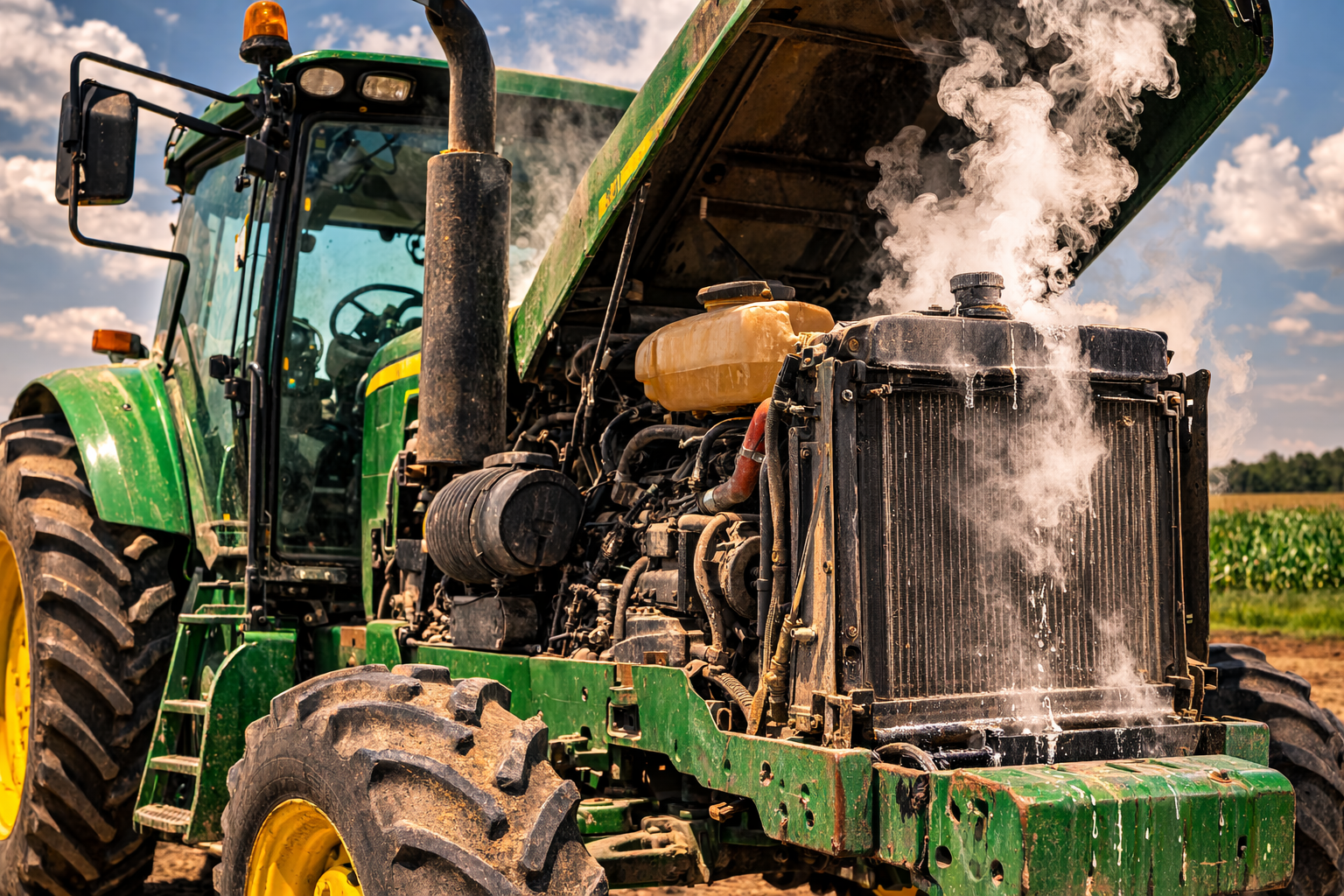
Fig. 8.2.1 "create an image of a tractor overheating" (prompt), ChatGPT, OpenAI, 15 Feb. 2026, https://chat.openai.com. Copyright status: No copyright claimed (U.S.); AI-generated work.