

8.3: The Troubleshooting Process
- Page ID
- 51944

\( \newcommand{\vecs}[1]{\overset { \scriptstyle \rightharpoonup} {\mathbf{#1}} } \)
\( \newcommand{\vecd}[1]{\overset{-\!-\!\rightharpoonup}{\vphantom{a}\smash {#1}}} \)
\( \newcommand{\dsum}{\displaystyle\sum\limits} \)
\( \newcommand{\dint}{\displaystyle\int\limits} \)
\( \newcommand{\dlim}{\displaystyle\lim\limits} \)
\( \newcommand{\id}{\mathrm{id}}\) \( \newcommand{\Span}{\mathrm{span}}\)
( \newcommand{\kernel}{\mathrm{null}\,}\) \( \newcommand{\range}{\mathrm{range}\,}\)
\( \newcommand{\RealPart}{\mathrm{Re}}\) \( \newcommand{\ImaginaryPart}{\mathrm{Im}}\)
\( \newcommand{\Argument}{\mathrm{Arg}}\) \( \newcommand{\norm}[1]{\| #1 \|}\)
\( \newcommand{\inner}[2]{\langle #1, #2 \rangle}\)
\( \newcommand{\Span}{\mathrm{span}}\)
\( \newcommand{\id}{\mathrm{id}}\)
\( \newcommand{\Span}{\mathrm{span}}\)
\( \newcommand{\kernel}{\mathrm{null}\,}\)
\( \newcommand{\range}{\mathrm{range}\,}\)
\( \newcommand{\RealPart}{\mathrm{Re}}\)
\( \newcommand{\ImaginaryPart}{\mathrm{Im}}\)
\( \newcommand{\Argument}{\mathrm{Arg}}\)
\( \newcommand{\norm}[1]{\| #1 \|}\)
\( \newcommand{\inner}[2]{\langle #1, #2 \rangle}\)
\( \newcommand{\Span}{\mathrm{span}}\) \( \newcommand{\AA}{\unicode[.8,0]{x212B}}\)
\( \newcommand{\vectorA}[1]{\vec{#1}} % arrow\)
\( \newcommand{\vectorAt}[1]{\vec{\text{#1}}} % arrow\)
\( \newcommand{\vectorB}[1]{\overset { \scriptstyle \rightharpoonup} {\mathbf{#1}} } \)
\( \newcommand{\vectorC}[1]{\textbf{#1}} \)
\( \newcommand{\vectorD}[1]{\overrightarrow{#1}} \)
\( \newcommand{\vectorDt}[1]{\overrightarrow{\text{#1}}} \)
\( \newcommand{\vectE}[1]{\overset{-\!-\!\rightharpoonup}{\vphantom{a}\smash{\mathbf {#1}}}} \)
\( \newcommand{\vecs}[1]{\overset { \scriptstyle \rightharpoonup} {\mathbf{#1}} } \)
\(\newcommand{\longvect}{\overrightarrow}\)
\( \newcommand{\vecd}[1]{\overset{-\!-\!\rightharpoonup}{\vphantom{a}\smash {#1}}} \)
\(\newcommand{\ket}[1]{\left| #1 \right>}\)
\(\newcommand{\bra}[1]{\left< #1 \right|}\)
\(\newcommand{\braket}[2]{\left< #1 \vphantom{#2} \right| \left. #2 \vphantom{#1} \right>}\)
\(\newcommand{\braopket}[3]{\left< #1 \vphantom{#2}\vphantom{#3} \right| #2 \vphantom{#1}\vphantom{#3} \left| #3 \vphantom{#1}\vphantom{#2} \right>}\)
\(\newcommand{\qmvec}[1]{\mathbf{\vec{#1}}}\)
\(\newcommand{\op}[1]{\hat{\mathbf{#1}}}\)
\(\newcommand{\expect}[1]{\langle #1 \rangle}\)
\(\newcommand{\dfn}[1]{\emph{\textbf{#1}}}\)
Effective troubleshooting follows a rhythm as disciplined as maintenance itself. Each step refines understanding, moving from general observation to specific cause. The best operators follow this process almost unconsciously, their actions guided by habit rather than haste.
1. Observe and Describe
Begin by defining the problem clearly. What exactly is happening, and when? “The tractor won’t start” becomes “the starter turns slowly after sitting overnight.” Precision in language leads to precision in thought. Record what the gauges show, what noises occur, and under what conditions the problem appears.
2. Consult
Before guessing, consult the operator’s manual or digital service guide. Many modern tractors include onboard diagnostics or fault codes; older models rely on mechanical logic. Manufacturer flowcharts or troubleshooting tables are not shortcuts—they’re the distilled reasoning of hundreds of engineers who’ve seen the same symptoms before.
3. Inspect
Check the simplest, most accessible components first: fuel, filters, and electrical connections. Half of all failures trace back to these points. A Fresno County technician once joked that “nine out of ten electrical problems start at the battery,” and experience bears him out—loose terminals, corrosion, and frayed ground straps cause more trouble than advanced sensors ever do.
4. Isolate
Once basics are confirmed, isolate the system in question. If the engine cranks but won’t fire, focus on fuel delivery and ignition rather than hydraulics or cooling. Close one valve, unplug one connector, and watch for change. Systematically removing possibilities prevents confusion and reveals patterns that random tinkering obscures.
5. Test
Testing means measurement. A multimeter, compression gauge, or hydraulic pressure gauge translates suspicion into data. Voltage drops, resistance readings, or fluid pressures confirm what the senses suggest. Never rely on intuition alone when instruments can speak more clearly.
6. Verify and Restore
After making a correction, retest the system under the same conditions that produced the failure. If the problem disappears, confirm that related components are still functioning. A clogged filter might have been the visible symptom, but the cause could be contamination upstream. Troubleshooting ends not when the symptom vanishes, but when its origin is understood.
This method may sound slow, but in practice it saves time. Random repairs waste effort; methodical reasoning builds knowledge. Over time, patterns emerge: certain sounds that always mean air in a line, or certain smells that always point to electrical overheating. Experience sharpens logic until troubleshooting becomes less about fixing and more about thinking mechanically.
As one Tulare County instructor once said, “A good operator isn’t the one who never breaks down—it’s the one who knows exactly why when it happens.”
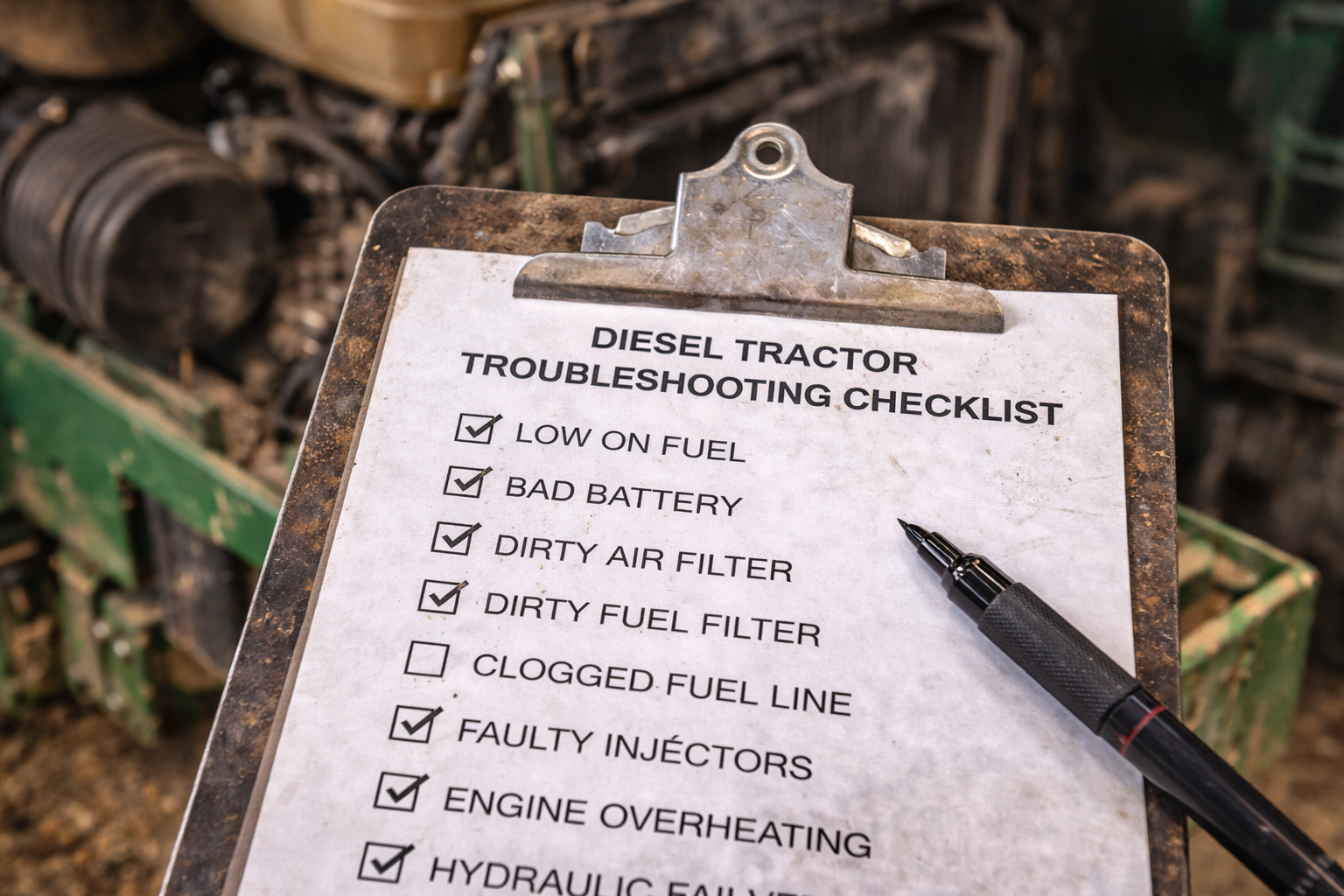
Fig. 8.3.1 "create an image of a tractor troubleshooting checklist" (prompt), ChatGPT, OpenAI, 15 Feb. 2026, https://chat.openai.com. Copyright status: No copyright claimed (U.S.); AI-generated work.